 VirtualCardx
SolCard 2026: Fees, KYC Tiers and the AI & Ads Card
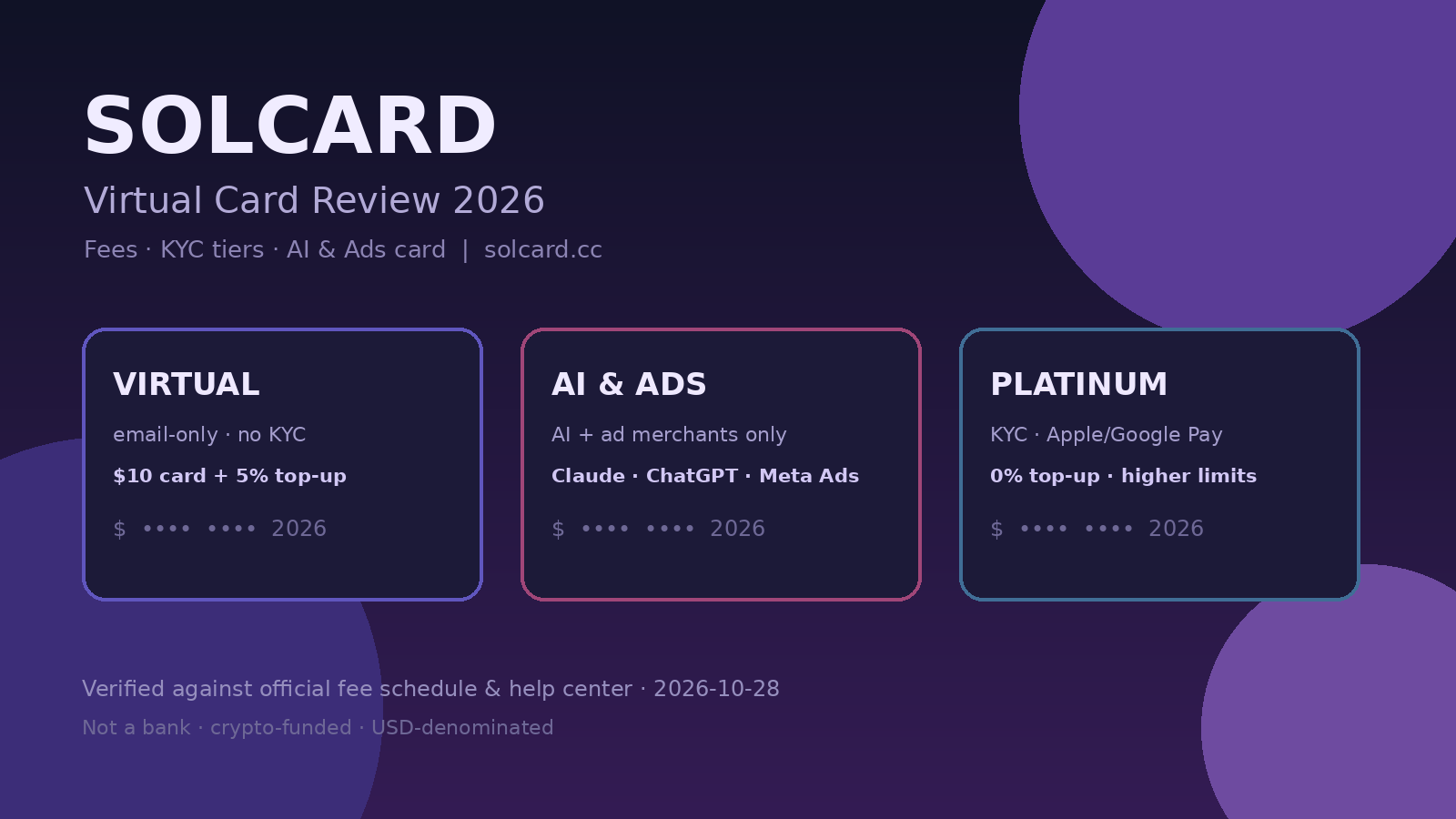
WildCard shut down in July 2025. DuPay followed that November, and its homepage still reads "Service terminated." The crypto-funded virtual card market that survived is smaller, noisier and, frankly, harder to shop in. SolCard is one of the louder names left standing: email-only signup, cards issued in a median of about 28 seconds, and a card tier built specifically for AI subscriptions and ad platform billing. This article was checked against SolCard's official fee schedule, help center, blocked merchant list and Terms of Use (last updated September 27, 2026) on October 28, 2026. Where the company hasn't published a number, we don't print one.
Who is actually behind SolCard
The legal operator is SC PAYMENTS LIMITED, a Hong Kong company with business registration number 78350827, registered at Unit 1603, The L. Plaza, 367-375 Queen's Road Central, Sheung Wan. Here's the part most reviews skip: SolCard's own terms describe the company as a program manager. It is not a bank, not an e-money institution, and not the card issuer. The cards come from a third-party licensed issuer that the terms decline to name. That arrangement is legal and common in this market, but it's a transparency gap you should price in before loading money.
Three structural facts from the official pages are worth knowing up front. Every card is virtual; the help center says plainly there are no physical cards for now. Accounts are denominated in USD. And Hong Kong residents are explicitly excluded from the service, with eligibility elsewhere described only as "may vary by region."
Three cards, three very different deals
Virtual Card. The email-only tier. No KYC. It costs $10 per new card plus 5% on every top-up, carries a 1-2% FX spread, and the official fee schedule (current as of August 15, 2026) caps spending at $10,000 per month. Some help center articles still cite $5,000. The two official pages disagree; trust whatever the app shows you at checkout.
Virtual for AI & Ad Spend. Same price as the Virtual ($10 card, 5% top-up), but it only works at AI services and advertising platforms. Everything else gets blocked by design. The official blog names Claude (including the Anthropic API), ChatGPT and the OpenAI API, Grok, Perplexity, DeepSeek, Cursor, Midjourney, Kling AI, ElevenLabs, Suno and OpenRouter on the AI side, plus Meta Ads, Google Ads and TikTok Ads for media buyers. The list is explicitly non-exhaustive. If your entire use case is "keep the AI subscriptions running and the ad accounts funded," a card that physically cannot leak money anywhere else is a feature, not a limitation.
Platinum Card. The KYC tier, and it flips the fee structure on its head: 0% top-up, 0-1.5% FX, no monthly cap on the fee schedule (the help center says $100,000 per month after verification). It's the only tier that supports Apple Pay and Google Pay, which also makes it the only one that works in physical stores.
The fee math, honestly
Start with SolCard's own worked example. To land a $100 balance on a new Virtual card, you send $115.26: $5.26 in top-up fees and the one-time $10 issuance fee. Your first $100 costs roughly 15% in fees. Topping up the same card again later costs the 5% fee only, which works out to about 5.26% of what actually lands. The first load gets cheaper in percentage terms as you scale, around 7% at $500 and about 6% at $1,000, but it never gets cheap. A third-party tracker, cryptoprepaid.cards, calls the Virtual tier's structure "among the most expensive we track." Their arithmetic holds up.
The transaction-level fees live in the help center's complete breakdown. Every successful purchase costs $0.30. Cross-border or currency-converted transactions cost 2%, and note the discrepancy: the fee schedule says 1-2% for Virtual and 0-1.5% for Platinum, while the help center says a flat 2% on all cards. Declined transactions cost $0.15, purchases under $10 cost $0.15, and both are marked as subject to change. Platinum users pay an extra 0.20% on Apple Pay and Google Pay spend.
Getting money out costs money too. Withdrawals to an external wallet cost $1 in USDT with a $20 minimum. Merchant refunds returned to your card balance lose 2%. Card-to-card transfers are free, with a $20 minimum and $5 that must stay behind on the source card. If you stake SOLC at the Essential tier or above, the withdrawal fee is waived.
The conclusion isn't subtle. For an occasional small subscription, a 15% all-in first load deserves a second thought. For frequent, larger spend, Platinum's 0% top-up is genuinely competitive, provided you're comfortable handing ID documents to a Hong Kong-registered company. That trade-off is personal; the numbers aren't.
Top-up rules and the 30-minute window
SolCard accepts deposits across 14 networks, a wider footprint than most competitors: Solana (SOL, USDC, USDT, EURC, SOLC, JITO, wBTC, wETH), Ethereum, Base, Arbitrum, Optimism (including USDT0), Polygon, BNB Chain, Avalanche C-Chain, HyperEVM, Robinhood Chain, Tron, plus on-chain Bitcoin and Litecoin.
Two rules deserve attention. Each top-up generates a unique deposit address and QR code, and the payment must confirm within 30 minutes, for the exact invoiced amount. And the help center warns in plain words that sending an unsupported asset or using the wrong network will lose your funds. Check the chain name and the asset twice before you send. Once payment confirms, Virtual and AI & Ads cards are issued automatically, with no manual review.
The tripwires that get cards killed
The blocked merchant list is more transparent here than at most platforms, which is to SolCard's credit. The standard Virtual card is blocked at PayPal, Wise, Binance, Eneba, OffGamers, Netflix, Starlink, Bolt, OnlyFans, gift card and gaming platforms, food delivery services and crypto-related services. The list is explicitly non-exhaustive.
The automatic cancellation rules matter more. Per the help center, a card gets killed after ten consecutive declines for insufficient balance, a decline rate above 20%, or repeated attempts at blocked merchants. Pile up failed subscription charges and the risk system can cancel the card without asking you first. If you run multiple subscriptions on one card, keep a buffer.
Three more boundaries. Virtual cards are online-only, and wallet-routing services like Curve are unsupported, so anything in-store requires Platinum. SolCard provides no fixed billing address; the help center says you may enter any valid US address when a merchant asks, though some merchants run address verification and may still decline. And since cards are USD-denominated, non-USD purchases pick up the FX spread.
Who should bother
If you already hold USDT or USDC and your problem is specifically AI subscriptions and ad platform billing, the AI & Ads card is a clean fit, and the blocked-everywhere-else design works in your favor. If you can pass KYC and spend at volume, Platinum's 0% top-up beats the archived rates of platforms that no longer exist; DuPay charged from 2.2% and OneKey Card came in around 2.75% all-in before each shut down. Those are historical figures, but they set the bar.
Who should skip it: anyone who needs PayPal or Netflix on the same card, Hong Kong residents, anyone without a way to buy crypto, and anyone planning to park a large balance. For a reminder of how quickly these platforms die, our directory keeps DuPay's shutdown timeline archived.
FAQ
- Does SolCard require KYC? The Virtual and AI & Ads cards work with email registration only. Platinum, and any limit increase, requires identity verification.
- Are there monthly or annual fees? No. Neither tier carries a monthly, annual or account maintenance charge.
- How do withdrawals work? $1 in USDT to an external wallet, $20 minimum, free for SOLC stakers at Essential tier and above.
- Is there a physical card? No. All cards are virtual for now.
- How fast is issuance? A median of about 28 seconds, per the official schedule's August 3, 2026 statistic.
- Can mainland China users register? The official pages only exclude Hong Kong residents; eligibility elsewhere "may vary by region," so treat the signup prompt as the final word.
Risks worth weighing before you fund a card
SolCard is not a bank, and its own terms say so: digital assets are not legal tender, not bank deposits, and not covered by any government-backed deposit insurance. The issuing bank behind the card program is unnamed, so you can't independently verify the upstream licensee. The official pages contradict each other on the monthly cap and the FX rate, so confirm the day's numbers in the app before loading. And the platform is young, with no full market cycle behind it; WildCard and DuPay both failed within roughly a year of their peak. Load what you need, spend it, repeat. A prepaid card is a spending tool, not a savings account.
Related reading
- OpenAI API usage tiers and card binding, explained
- OpenRouter credits and payments: fees, 402/429 errors and invoices
- Midjourney subscription payments and virtual cards
Official sources
- SolCard Fees (official fee schedule, current as of August 15, 2026; checked October 28, 2026)
- SolCard Fees Complete Breakdown (help center; checked October 28, 2026)
- Prohibited Merchants & Blocked Transactions (checked October 28, 2026)
- How to Get Your SolCard (issuance flow and limit figures; checked October 28, 2026)
- SolCard Terms of Use (updated September 27, 2026; checked October 28, 2026)
- Virtual for AI & Ad Spend (official blog, supported merchant list; checked October 28, 2026)
- Third-party reference: cryptoprepaid.cards, "SolCard Review" (fee comparison figures; accessed October 28, 2026)