
Virtual CardsPaymentsTechAI ToolsSEOSocial & TradeCryptoFree Resources

China-Accessible AI API Relay Services: Tested List
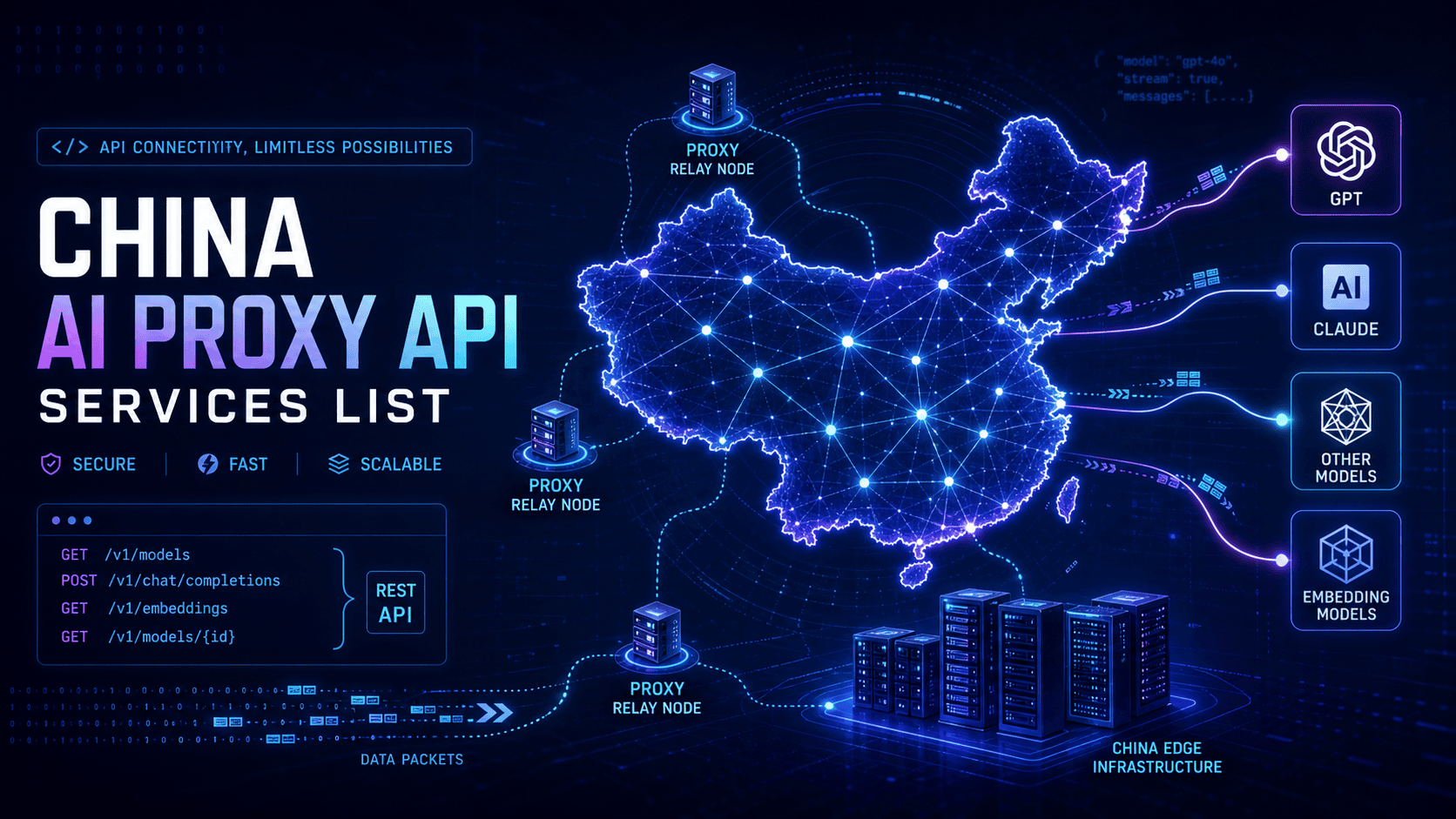
Why Do We Need to Talk About API Relay Services Accessible in China?

Late last Wednesday night, a cross-border e-commerce customer-service chatbot project I'm working on suddenly started erroring. Digging through the logs, the open-source LLM's native API I'd been using had become completely unreachable due to network fluctuations. As someone who regularly shares foreign-trade tech experience on virtualcardx.com, my first instinct was to use the virtual credit card I always keep ready to open an official API with AWS or OpenAI. But the reality is that even after solving the account and payment problems, direct connections from domestic servers to those official API endpoints have absurd latency - timeouts are routine.

Many indie developers and small technical teams who ask me for tooling advice fall into the same trap: they think that with an overseas account and a virtual card, API calls will just flow. That's not how it works. For developing AI applications inside mainland China, AI API relay services are the best balance of cost, stability, and network connectivity. After several sleepless nights testing the mainstream providers, here's my curated, tested list of China-accessible API relay services - I hope it saves you some detours.

Tested List of Mainstream AI API Relay Services

For this round of testing, I focused on three metrics: latency from domestic servers, multi-model support, and billing transparency. The test network was a standard BGP line in a Beijing IDC data center.

1. API2D: Established and Stable, Good for Enterprise Use

This is one of the most famous relay services in China's going-global community. I mainly use it for GPT-4o and Claude 3.5 Sonnet endpoints.

  • Tested speed: domestic direct-connect latency fluctuates between 180ms-250ms; cold starts are a bit slow, but long-text streaming is very stable.
  • Integration cost: fully compatible with the OpenAI SDK - just swap the base_url in your code to their relay address and nothing else changes.
  • Billing: supports CNY top-ups (Alipay/WeChat Pay), no foreign-currency credit card needed. Per-token billing at roughly 1.1x official prices.
  • Downside: occasional rate limiting during peak hours (8-11pm Beijing time); add retry logic in production.

2. OhMyGPT: Multi-Model Aggregation with Great Latency

If your app needs not just OpenAI but also Llama 3 or Gemini, OhMyGPT is a solid aggregation gateway. I ran a concurrent test script in Python against it.

  • Tested speed: they have multiple acceleration nodes in China - my test against the Shanghai node hit under 90ms, a huge advantage for real-time voice AI scenarios.
  • Payment and compatibility: also supports native Alipay. Their specialty is deep integration with mainstream frameworks like LangChain and LlamaIndex.
  • Downside: the admin console is bare-bones; if you want detailed per-day API usage bills, the exported Excel is messy and needs custom cleanup scripts.

3. CloseAI (Not the Official OpenAI): Extreme Value

Note: this CloseAI is a domestic Chinese technical team doing API distribution - not the official OpenAI. Many indie developers call it the "budget official".

  • Tested speed: latency is unstable, jumping between 150ms-400ms. They route over a special line; sometimes daytime busy hours are faster than late night.
  • Core advantage: cheap. Instead of proportional official token pricing, they offer monthly plans or low per-use rates. I tested 100,000 GPT-4o-mini calls for under 30% of official cost.
  • Warning: this kind of service depends heavily on upstream channels. My advice: never use it in core production environments - it's best for test environments, personal bots, or batch data cleaning. If you push too much volume and trip their risk controls, your balance can vanish.

Native API vs. Relay API: Pros and Cons

Many readers ask me via virtualcardx.com's dashboard: since you have a virtual credit card, why not subscribe to the official API directly? Here's a data-driven breakdown:

  • Payment chain: official APIs require 3D-verified credit cards and extremely strict IP risk controls - accounts get banned easily; relay APIs just need a QR-code scan payment with no ban risk.
  • Network connectivity: calling official endpoints from domestic servers requires you to run your own overseas proxy (e.g., a Hong Kong or Japan VPS) - extra ops cost and at least 100ms added single-hop latency; quality relay APIs come with optimized BGP networking - just point your code at them directly.
  • Billing granularity: official pay-as-you-go pricing is brutal for high-frequency, small-request workloads; some relay APIs offer unlimited plans or heavily discounted quota.

Three Hard Recommendations for Choosing a Relay API

The biggest fears with relay services are exit scams and data leaks. Based on years of stepping on rakes, here are practical rules:

First, test small before going big. No matter how amazing a provider sounds, top up just 10 yuan first and run your business flow end-to-end. Write a concurrency script and check whether the RPS they promise actually holds. Many small services start throwing 502s past 50 concurrent requests.

Second, mind data privacy and desensitization. A relay service is fundamentally forwarding your requests to the LLM vendor. Don't blindly trust "we don't log anything" claims. If you're handling real foreign-trade client order info, addresses, or phone numbers, desensitize and encrypt before sending - or just self-host an open-source model locally.

Third, build multi-channel failover. At the code level, abstract a unified API Router layer. My current system routes primary requests to API2D, and if it hits a timeout or runs out of balance, it automatically falls back to OhMyGPT within 300ms.

In summary: if you're a startup AI developer or foreign-trade team wanting to validate a product quickly, the most hassle-free choice is an aggregated relay API that supports Alipay with transparent pricing. Later, as volume grows, consider using a virtual credit card to get an officially compliant endpoint like Azure OpenAI. Choosing the right toolchain saves you a huge amount of trial-and-error cost on your way to going global.