Account Opening Address:https://api.visapay.cc/h5/login

Look at the interface. It's a real domestic flavor.
The usual. Check the whois.
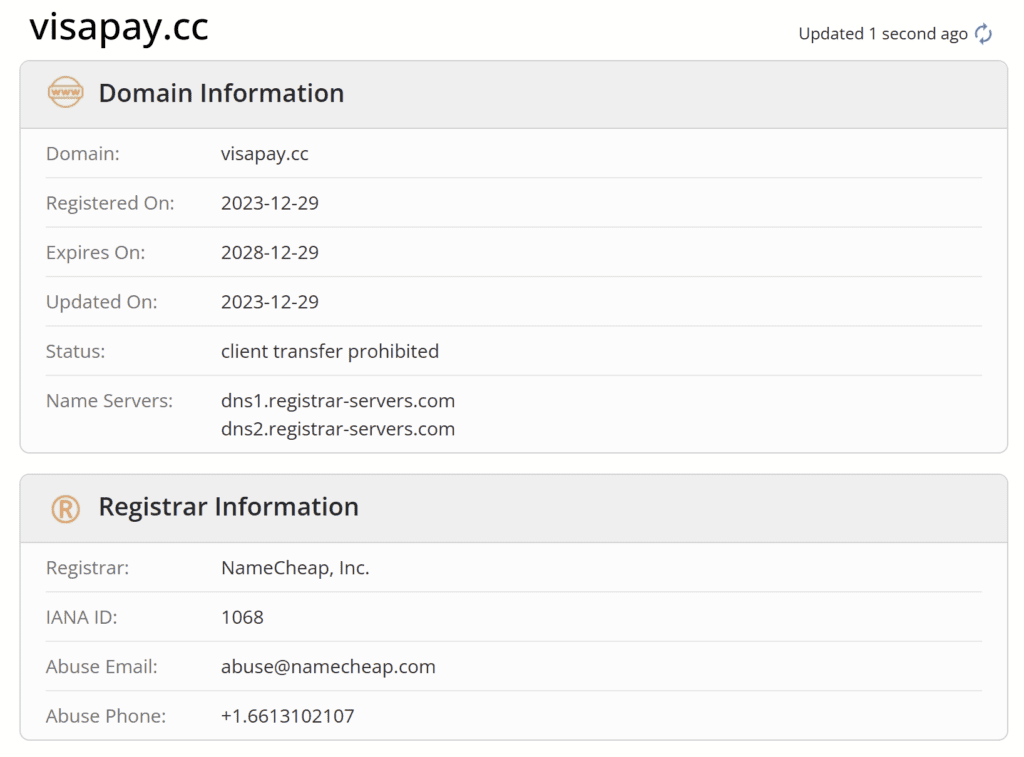
Not bad domain name starts in 2023, renewed until 2028
Domestic platforms slightly larger in addition to pengcard and fomepay run away, before using a few okay, when the exit will also issue a statement, step by step to clear the retreat
Evaluation: Make do with what you've got
I. Basic information on the platform
Visapay is a virtual card service provider that serves cross-border practitioners. Its business covers card BINs in Hong Kong, the United States and other countries, and is able to provide cross-border practitioners with domestic and international virtual card services.
II. Card Types and Applicable Scenarios
The platform provides virtual cards from VISA, MASTER and other organizations, including US dollar cards in the US and Hong Kong dollar cards in Hong Kong. These virtual cards are applicable to a number of cross-border scenarios, such as the payment of store rent and advertising fees on cross-border e-commerce platforms such as Amazon, Shopify, Shopee, etc., the payment of advertising fees on platforms such as Facebook, Google, Tiktok, etc., the consumption of offshore e-commerce shopping and the payment of cloud servers, domain names, network tools and other expenses.
III. Core Functions and Usage Experience
(i) Card issuance and management
The platform supports free registration and account opening, users can complete the process from registration to card opening within 1 minute, and no manual intervention, the system is fully automatic audit. Users can open unlimited cards according to their own needs, in the self-service background can easily complete the card generation, recharge, cancel the card and other operations, the process is simple and efficient.
(ii) Operation of funds
Supporting the mainstream payment methods on the market, users can use their personal accounts or corporate accounts to make deposits, and the funds can arrive in real time. The platform has multi-currency e-wallet, users can convert between wallets of different currencies, using real-time exchange rates, to avoid exchange rate losses, to achieve the recharge, transfer, payment of integrated operation.
(iii) Safety and security
There are multiple guarantees for fund security. In the incoming link, the receiving channel and the bank will verify the source of funds and restrict the objects to which the funds are transferred out of the enterprise account to ensure that the funds are controllable; in the payment link, the card issuer will restrict the objects to which the payments are made, so that non-compliant and illegal platforms are unable to carry out the payments; in the settlement link, VISA and MASTER are responsible for the funds clearing and returning the payment results, so that each flow of funds is clear and traceable.
IV. Summary
Visapay's virtual card platform has certain characteristics in terms of card type, applicable scenarios, card opening management, fund operation and security, etc., and can provide convenient virtual card payment services for foreign trade and cross-border industry practitioners. Practitioners can consider whether to choose the platform's virtual card products according to their own business needs.
Virtual Card Platform Roundup—Visapay Virtual Card Platform: Check These Points Before Reading
Policies regarding virtual credit cards, U-cards, and encrypted payment platforms change rapidly. Card issuance fees, top-up rates, KYC requirements, supported platforms, and risk control rules are all subject to change at short notice. Therefore, when reviewing information about these platforms, don’t just focus on individual fee figures; instead, verify whether the platform is still operating normally, whether it supports your specific payment needs, and whether you can withdraw or transfer funds from your account at any time.
If you plan to use this type of card to pay for ChatGPT, advertising accounts, cloud servers, overseas shopping subscriptions, or cross-border SaaS services, we recommend starting with a small amount to test it out. Once you’ve confirmed it works, gradually increase the amount you load onto the card. Avoid keeping a large balance on a single platform for an extended period right from the start—especially on platforms that lack a clear corporate entity, have slow customer service response times, or have received a lot of negative feedback from the community.
Items to Check Carefully
- KYC Requirements:Confirm whether it is completely KYC-free, has a low KYC threshold, or requires verification only after reaching a certain limit.
- Payment Methods:Check whether USDT, bank cards, Alipay, WeChat Pay, or other payment methods are supported, and calculate the actual loss incurred upon receipt of funds.
- Card Organizations and Card Series:The acceptance rates for Visa, Mastercard, prepaid cards, debit cards, and corporate cards vary significantly across different platforms.
- Consumer Scenarios:Make sure to verify whether the platform supports ad placement, AI subscriptions, international e-commerce, hotel and flight bookings, PayPal, or Apple Pay.
- Risk Control Rules:Familiarize yourself with the rules regarding account freezes, chargebacks, refunds, card cancellations, and balance withdrawals to avoid having your funds held up later.
Recommendations for Use
A safer approach is to have at least two alternative platforms ready: one for regular subscription payments, one for advertising or high-frequency transactions, and one as a temporary backup. This way, even if a platform undergoes temporary maintenance, a payment range is rejected, or fees are raised, it won’t affect ongoing business operations.
If a platform advertises “zero fees,” “permanent KYC exemption,” or “guaranteed approval in any scenario,” you should be even more cautious. Whether a virtual card can successfully process a payment typically depends on the issuing region, MCC, the merchant’s risk control measures, the billing address, the IP environment, and the transaction history—factors that no single platform can guarantee on its own.
Frequently Asked Questions
Are platforms that don't require KYC really better?Not necessarily. While waiving KYC requirements lowers the barrier to opening an account, it may also lead to issues such as low credit limits, strict risk controls, and slow customer service response times. It is suitable for small amounts, temporary needs, and situations requiring a high degree of privacy, but is not suitable for long-term storage of large sums of money.
Why can I use the same virtual card to make payments on some websites but not on others?Different merchants check the card range, billing address, IP address, device environment, and historical chargeback rate. Just because a card is valid doesn’t mean all platforms will accept it.
How can you reduce the likelihood of running into problems?First, check recent reviews, then make a small deposit to test the platform. Be sure to keep records of your transactions and screenshots of your communications with customer service, and avoid leaving a balance sitting in an unfamiliar platform for long periods of time.










 English
  Chinese