 VirtualCardx
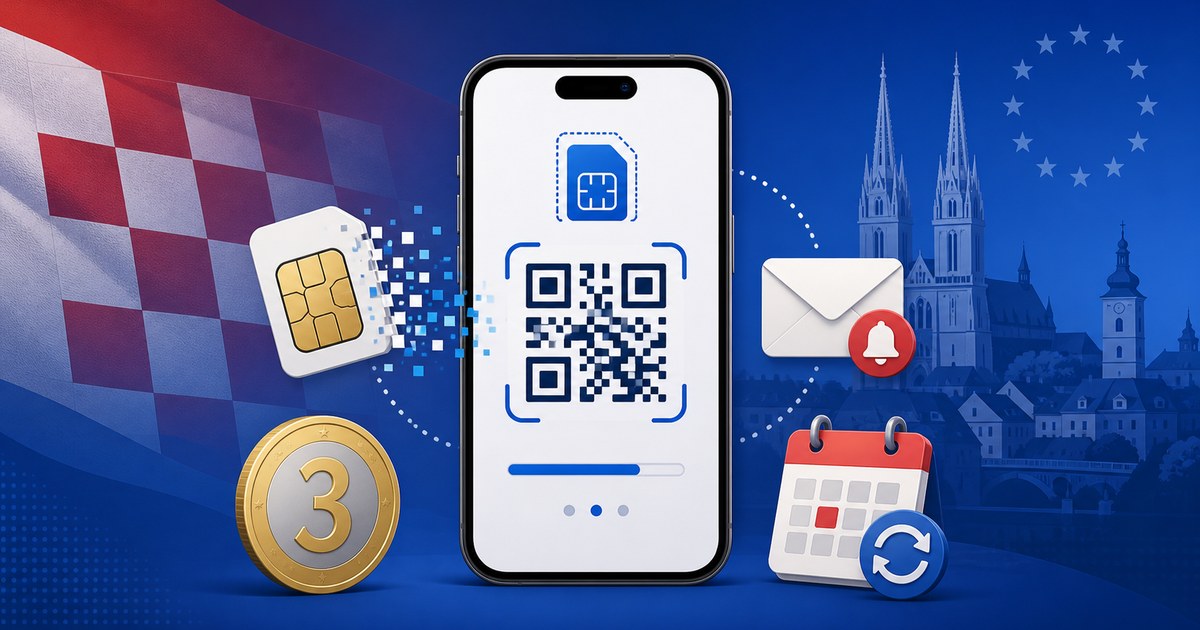
A1 Croatia eSIM: EUR 3 SIM, EUR 2/Year Keep-Alive
Verification note — September 15, 2026
Prices, plans, eligibility, regional availability, fees, USSD codes, network costs and service status in this article can change without notice. This review uses A1 Hrvatska prepaid/eSIM pages as the official recheck point. Historical figures and hands-on observations remain dated context, not a current quote, availability promise, or payment-success guarantee. Before buying, topping up, moving assets, or sending an on-chain transaction, recheck region, tax, network and expiry on the provider’s final checkout, app/support channel, or wallet confirmation screen.
Why a Croatian Number Became a Thing
Through 2026, risk engines at international services kept tightening on +86 numbers — ChatGPT, broker apps, and payment platforms increasingly delay or refuse codes to mainland Chinese numbers. That amplified a niche demand: a backup overseas number that costs almost nothing, receives verification codes, and stays alive cheaply for years. A1 Croatia's EUR 3 eSIM sits exactly on that point: the setup costs about a coffee, and keeping the number alive costs about one bubble tea per year.
A1 Hrvatska is the Croatian arm of the A1 Group (the former Telekom Austria, now controlled by América Móvil), operating its own national network — not an MVNO reselling someone else's capacity. The +385 numbers it issues are proper carrier numbers, which is why country-detection at major platforms treats them as EU numbers with normal international SMS routing.
Ordering: Five Minutes, Fully Online
Entry point. Go to the SIM-promo page on a1.hr. The page is in Croatian; the big button you want reads "Želim novi eSIM broj" (I want a new eSIM number). There's an English toggle top-right, but the Croatian page is actually the smoother path.
Order. Enter your regular email (the QR code and the number go there), pick eSIM — the page also sells physical SIMs, but those only ship inside Croatia — and pay EUR 3. Cards, Apple Pay, and Google Pay all worked in testing. Some issuing banks trigger 3-D Secure for a Croatian merchant, so watch for your bank app's push notification.
Activate. Minutes after payment, an email arrives with the eSIM QR code and your assigned +385 number. On iOS: Settings → Cellular → Add eSIM; Android paths vary but all require internet. A1's own FAQ confirms the eSIM can be activated while roaming abroad, without ever touching the A1 network — you can complete the entire flow from China on Wi-Fi.
The EUR 3 comes back. The promo page states the amount is returned as account credit ("vraćamo ti 3 € na račun") — usable for data bundles or calls, making the effective setup cost zero. After activation, record three things: the phone number, the ICCID (visible in device settings), and the order email.
The Validity Math Everyone Gets Half-Right
The card's viral claim is "EUR 2 keeps the number a year." Here's what actually happens:
- First activation: 180 days of full service — calls, SMS, and data against the returned credit.
- Later top-ups: EUR 2 buys 92 days of full service. The 180-day grant is one-time; the EUR 2–14 top-up band maps to 92 days.
- After that lapses: a 270-day recharge window. The number still receives calls and SMS and can be revived by a top-up — but no reliable outgoing calls, SMS, or data.
- After the window: the number is recycled and any balance forfeited.
So "EUR 2 per year" really means 92 + 270 = 362 days of number survival, not 362 days of service. If you only receive codes — the most common use — the recharge window receives SMS just fine, and EUR 2 genuinely covers the year. If you need to send SMS regularly, you must top up every 80–90 days to stay in full service, roughly EUR 8–10 a year.
Top-ups happen at a1.hr/kupi-bon: enter the +385 number, choose a custom amount (EUR 2 tested as the minimum), pay by card or PayPal. A1 confirms that topping up during the recharge window preserves the old balance — new credit stacks on top.
China Roaming: One Field Test, Big Platform Differences
A single-round test on 2026-08-17 (SMS deliverability depends on platform risk control, routing, and the roaming network — your mileage will vary):
| Roaming network | Platform | Result |
|---|---|---|
| China Mobile | All tested | Registered, no SMS received |
| China Unicom | ChatGPT | ✅ Delivered |
| China Unicom | Tiger Brokers | ✅ Delivered |
| China Unicom | BIT | ✅ Delivered |
| China Unicom | NiHao China | ❌ Not delivered |
The pattern: roam on China Unicom (the SMS path under China Mobile appears broken for this carrier), and international platforms deliver more reliably than small regional ones. Before migrating any binding, send a test code from each platform you care about.
What to Bind — and What Never To
Fits: a low-frequency backup number; a Croatian/EU number prepared before travel; non-critical, replaceable service sign-ups; a secondary contact line.
Never as the sole number for: banks, brokerages, crypto exchanges — one failed code can lock an account; your primary email's only recovery path — number recycling bricks the mailbox; or as your main daily card roaming in China — the data rates aren't designed for it.
How It Compares in the Cheap-Backup-Number Field
- A1 Croatia (this card): EUR 3 setup returned as credit, EUR 2/362 days. Instant eSIM, no KYC today. Weak spot: no SMS under China Mobile roaming.
- UK giffgaff: free SIM during promos, keep-alive by sending one SMS or using a trickle of data every 6 months. Great delivery rates, but physical SIM shipping times and a customer-service-gated eSIM swap.
- US Tello / US Mobile PayGo: from ~$5/month, high-value US numbers — 20× the annual cost, and you need a US payment method.
- Poland / Baltics prepaid eSIMs: similar EUR 2–3 economics, far less community validation.
Verdict: for "hold an EU number near zero cost, receive occasional codes," A1 Croatia is currently the smoothest and best-validated option. Even at the continuous-service tier (EUR 8–10/year) it stays cheap — just keep the platform-delivery caveat in mind and run dual-number redundancy for anything that matters.
Migration Playbook
- Test before binding: send a code from every target platform; drop the ones that fail.
- Tier the migration: low-risk services directly; medium-risk (social, secondary emails) as a second number, never the only one; high-risk (banks, exchanges) as backup only.
- Keep an exit: every migrated account keeps a second recovery path (email, TOTP, backup codes). Screenshot the QR email and ICCID.
- Calendar the top-ups: day 430 (keep-alive) or every 80 days (full service). Miss the window and every binding dies with the number.
FAQ
Q: Can I receive codes during the 270-day window?
Yes — incoming calls and SMS keep working, which is exactly what the EUR 2/year plan depends on. Still, don't park critical verifications at the window's tail end.
Q: Switching phones?
Delete the eSIM profile on the old device first, then re-scan the original QR on the new one. The redownload count on a single QR is limited.
Q: Does balance expire?
Balance follows the validity period; topping up in the recharge window revives the old balance. Unused credit dies with a recycled number.
Q: Can I use data on it in China?
Technically yes (roaming, pay-as-you-go), but pricing is poor and the China Mobile SMS path already proved fragile. Buy a travel eSIM for data instead.
Further reading: to compare keep-alive SIMs and travel eSIMs across countries — prices, coverage and validity rules — see SimDirs' A1 Croatia entry and the full SIM card directory.