 VirtualCardx
PrivCards Virtual Card Review: $1.50 Fee, Real Risks
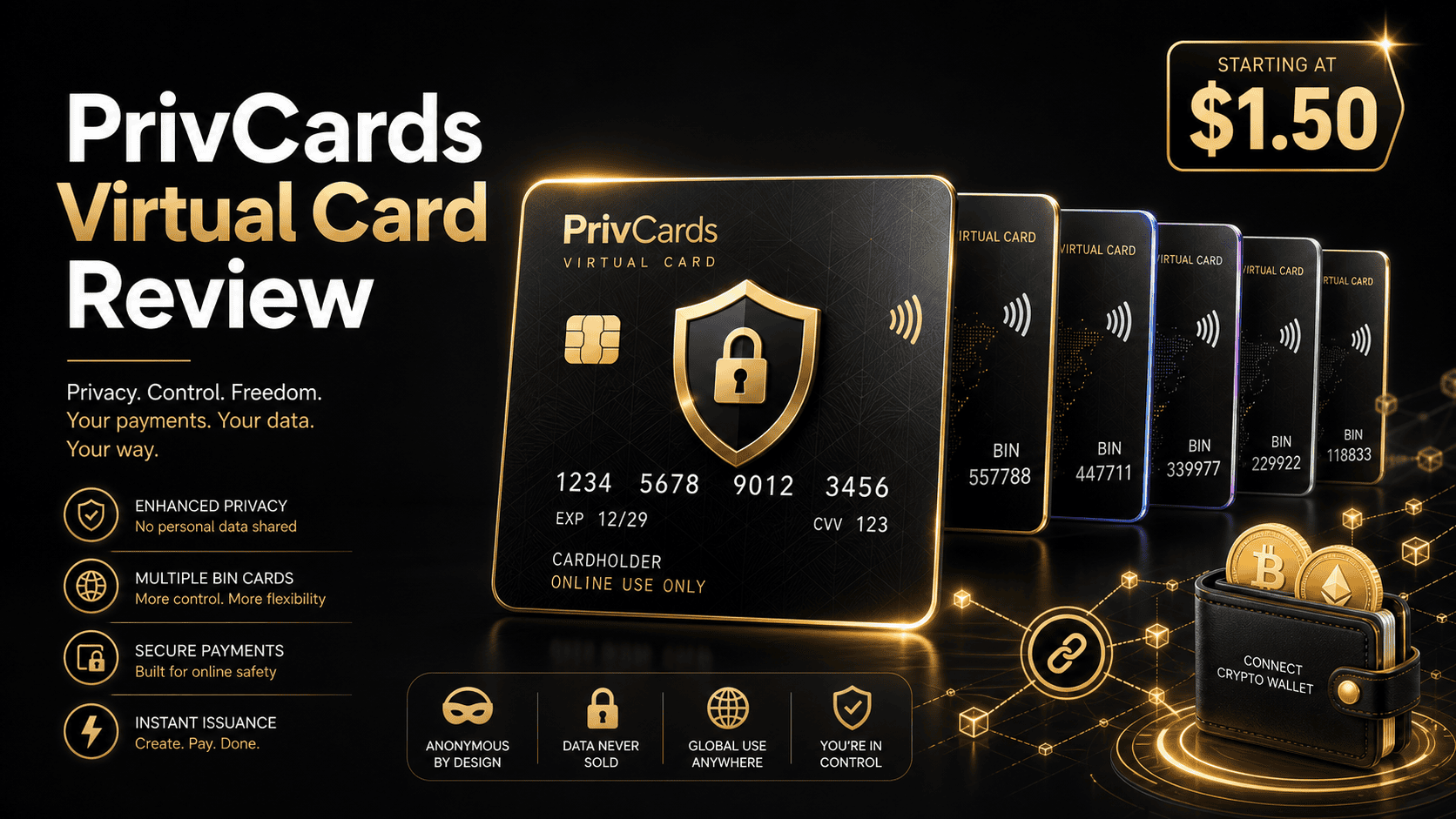
PrivCards Virtual Card Review: The $1.50 activation fee is very affordable, but there are also clear red flags
Lately, quite a few people have been asking me in my private messages about PrivCards, a virtual credit card platform. After seeing the slogan “Open a card for as low as $1.50” on their homepage, I topped up my account with 50 USDT last week to test it out. As a blogger who has been reviewing virtual cards on virtualcardx.com, I’ve seen far too many platforms that lure users in with low prices only to collapse later. In today’s review, I’ll share PrivCards’ card activation costs, BIN data, and its risk control performance in real-world use—with complete transparency.
Verification update (2026-09-15):The site https://privcards.com was reachable on 2026-09-15; its public terms describe crypto-funded prepaid Visa/Mastercard cards and a no-KYC model. The claimed personal test, fixed $1.50/2%/1.5% prices, BIN and approval results were not reproduced in this review. No KYC does not mean anonymous, risk-free or globally available; use current terms and checkout.
The $1.50 Card Activation Fee and Practical Details
I actually went through the process of activating a Visa card. At first glance, the $1.50 activation fee is indeed very competitive in today’s virtual card market; compared to WildCard or Dupay, which often charge around $10 for activation, the barrier to entry is much lower. However, there are several hidden costs to be aware of during the actual top-up and activation process.
- Card Activation Fee:A one-way ticket really does cost only $1.50.
- Deposit Fees:I used USDT (TRC20) to make a deposit, and the platform charged a deposit fee of 2%, so when I deposited $50, I actually received $49.
- Cross-border/Non-USD Transaction Fees:If used to pay in a currency other than the U.S. dollar, there will be an exchange rate conversion fee of approximately 1.5%.
So, all things considered, although opening the card costs only $1.50, fees start accruing as soon as funds are deposited. However, for users who only need to verify their card with a small amount, this cost is still acceptable.
Key Data: PrivCards BIN Prefix Information
When it comes to virtual credit cards, the BIN (Bank Identification Number) determines the card’s pedigree and success rate. The card I activated has a BIN of 4996xx, Here’s a technical breakdown for everyone:
- Card Organizations:Visa
- Card Type:Credit (Credit Card)
- Issuing Country:United States (US)
This BIN segment is fairly common in the virtual card community. During testing, I found that its AVS (Address Verification System) checks are relatively lenient. I randomly entered a billing address in a tax-free state, and the payment verification passed instantly. This lenient mechanism is very beginner-friendly, but it’s also a double-edged sword—because of the lax risk controls, it often gets flagged by the risk control systems of some high-tier merchants.
Real-World Testing: Subscriptions, Store Linking, and Ad Spend
1. Subscribe to ChatGPT Plus and AI software
This is the main reason most people buy these low-cost cards. I linked this card to my OpenAI account and tried to pay $20 for a Plus membership. The first time, I got the message “Your card was declined.” I suspected my IP address might not be “clean,” so I switched to a residential IP and tried again—the payment went through successfully. It also worked normally when linking Claude and Midjourney. This indicates that this card series does not block merchant category codes (MCCs) for AI subscriptions, but it is highly dependent on your IP environment.
2. Linking Facebook/Google Ad Accounts
I tried linking this card to a brand-new Facebook personal advertising account. The result was disastrous: not only did the direct linking fail, but Facebook suspended my account immediately. This indicates that 4996xx This BIN is most likely already flagged by Meta’s risk control system as a high-risk virtual card. If you run an independent e-commerce site for international trade or manage ad campaigns, you should absolutely avoid using this card to link to new accounts—the account suspension rate is extremely high.
3. Everyday Spending and Linking a Card to the Platform
It passed the test of purchasing a gift card on Amazon. Linking an Apple ID was also a breeze. Overall, it’s suitable for everyday digital purchases and software subscriptions.
Summary of the Pros and Cons of PrivCards Virtual Cards
After a week of intensive testing, I’ve summarized the pros and cons of PrivCards below for your reference:
Advantages:
- Lowest Price Guaranteed:Card activation costs $1.50, which is easy on the budget and ideal for temporary projects or one-time card verification needs.
- Low minimum deposit requirement:Supports USDT (TRC20); there are no KYC verification delays, or the verification process is very simple.
- Smooth Payment Network:The success rates for standard AI subscriptions, domain name purchases, and app store purchases are reasonably good.
Drawbacks and Warning Signs:
- Questions About the Platform's Stability:A $1.50 card activation fee indicates that the platform’s profit margin is extremely thin. In the cross-border payments industry, pricing that is far below the industry average often suggests that the platform is using users“ deposited funds for other purposes, and there is even a risk that it could cease operations and ”run away” at any time.
- High-Risk BIN Flags:It cannot be linked to major ad platforms, which can easily trigger merchants' risk control measures.
- Slow customer service response:During testing, I encountered an issue where the page froze, resulting in an incorrect balance deduction. It took nearly 5 hours of waiting for online customer service to resolve the issue.
Blogger's Recommendation: Who is this card best for?
My original intention in writing reviews on virtualcardx.com was to help everyone avoid pitfalls. As for PrivCards, my conclusion is clear:You can use it, but definitely don't top up with large amounts.
If you're just a student, or if you just want to spend a few dollars to take advantage of a 7-day trial for overseas software, then PrivCards—at just $1.50—is an absolute lifesaver. Even if the platform goes under, you'll only lose a few dollars at most.
However, if you’re a cross-border e-commerce seller who needs to link your store for long-term payments, or a heavy AI user who relies on ChatGPT Plus for consistent, long-term use, I don’t recommend tying your core business to these low-cost, high-risk cards. If the platform is subject to a settlement by the issuing bank or goes out of business, your account is likely to be suspended due to interrupted payments. I recommend that everyone compare reviews of other established card providers on virtualcardx.com before making a purchase, and prioritize platforms that offer financial security and have cleaner BIN ranges.